
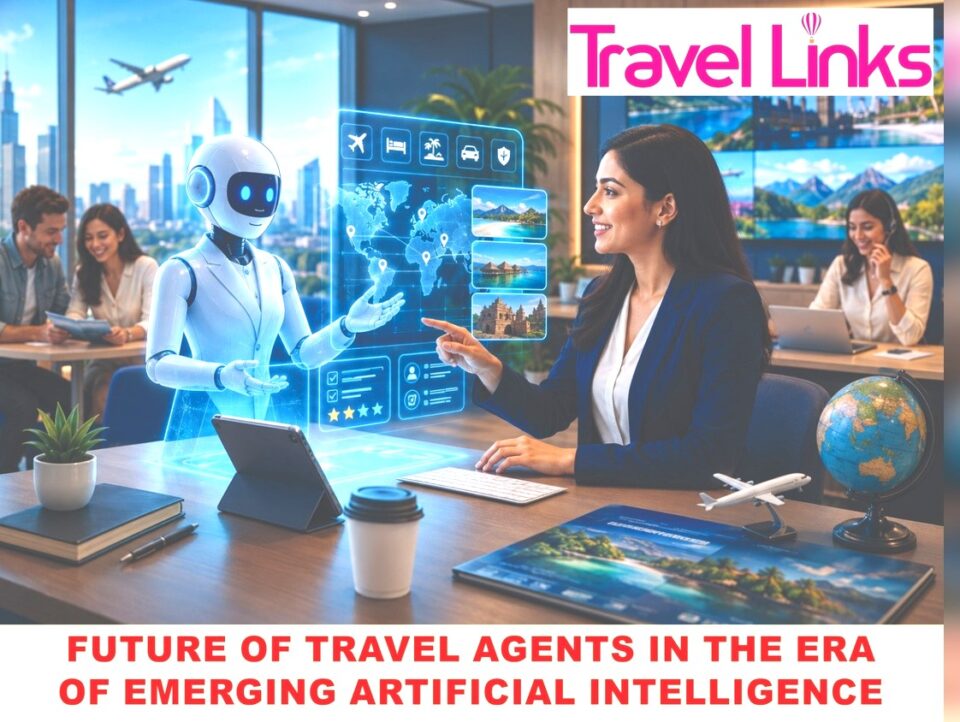

AI VS TRAVEL AGENT: WHO WILL OWN THE TRAVELLER? An interactive topic by Travel Links
Artificial intelligence is changing how people discover, compare and plan travel. But when the holiday goes wrong, who will the traveller trust—a machine or a human? There was a time when the first step in planning a holiday was calling a travel agent. Today, it may be opening ChatGPT, Gemini, or another AI-powered travel tool.
A traveller can type a simple request—“Plan a 10-day luxury family holiday in Japan under ₹8 lakh”—and within seconds receive a suggested itinerary, hotels, restaurants, transport options and sightseeing recommendations. The speed is impressive. The implications for the travel trade are even more significant.
Artificial intelligence is no longer merely a back-office productivity tool. It is moving into the very heart of the travel journey: inspiration, discovery, itinerary planning, comparison, customer service and increasingly, booking.
We at Travel Links Top 5 Travel Trade Travel luxury Magazine Travel Links spoke to the travel trade fraternity, and that’s what they have to say:
“AI and travel agents will work hand in glove in the future. Agents now have to create an itinerary. They discuss and make alterations based on the customer’s choice. AI will create itineraries that sometimes do and sometimes do not suit a customer. But AI creating an itinerary will shorten the time spent on discussions and suggestions. Agents negotiate good rates of hotels with flexible cancellation rules. They have reliable ground handlers. And with the number of both outbound and domestic travellers increasing (outbound 40 million approx + domestic 1.5 billion+10 million inbound), both will co-exist”. By Guldeep Singh Sahni Managing Director, Weldon Tours & Travels Pvt Ltd; Co-chairperson, FICCI Executive Committee member, PATA
“As Former President of TAAI and a leader in tourism, I have long advocated that technology and AI will transform how travellers discover, plan, and book journeys—but they will never replace the human essence of tourism. Technology is an enabler, streamlining logistics, offering personalization at scale, and enhancing efficiency. Yet travel’s true value lies in people-to-people connections, cultural immersion, and trust. Professional travel advisors bring lived expertise, insider access, and crisis management that no algorithm can replicate. The future is not AI versus travel agents, but collaboration: AI will manage the mechanics, while advisors elevate experiences with empathy, storytelling, and human touch. In this way, AI will make travel advisors more valuable than ever, ensuring tourism remains rooted in authentic human connection. By Jyoti Mayal, Chairperson, Tourism & Hospitality Skill Council (THSC), Former President, Travel Agents Association of India (TAAI)
AI is rapidly becoming the order of the day, and the travel industry is no exception. For the travel professional, the ability to embrace and adapt to AI will increasingly determine who moves ahead and who risks being left behind. “I have always maintained that *_AI knows everything, but it does not necessarily understand everything. As human beings, we may not know everything, but we understand most of everything. We understand people, emotions, preferences, circumstances, and the nuances behind a traveler’s requirements. Most importantly, we bring experience, judgment, relationships, and accountability. A traveller may get knowledge from AI. But it is a good consultant who can respond to “why’s than “whats”, which is most required when your design is to offer experiences.
The BIG opportunity can be when AI and a skilled Travel Consultant blend their strengths. Once we master this art, we enter an era of the Travel Consultant of the Future and can better interact with our customers, particularly those who become dependent on AI for more knowledge or information. That blend of artificial intelligence and human intelligence can create a more powerful, more personal, and ultimately more successful travel experience”. By Taai President Sunil Kumar
**AI will not replace travel agents—it will replace travel agents who do not adapt to AI.**
“AI is incredibly powerful at researching destinations, comparing options, creating itineraries, and providing instant answers. But travel is not just about information. It is about **experience, trust, relationships, personal understanding, and taking responsibility when things go wrong.** When a flight is cancelled, a family faces an emergency, a visa issue arises, or a complex group trip needs to be reorganised overnight, travellers want a **human being who knows them, understands their priorities and can take ownership of the situation.**The future, therefore, belongs to the **AI-enabled travel advisor**—someone who combines the speed and intelligence of AI with human judgement, relationships and accountability. But the travel advisor who earns the traveller’s trust will win the relationship.** Ultimately, **AI won’t own the traveller. The professional who uses AI best—and still puts the traveller first—will.”** By S K Dewan, Director, Dewan Travels
“I don’t think AI will replace travel agents. It will definitely make planning easier, but travellers still need someone they can trust for the right advice, personal attention and support when things don’t go as planned. I believe AI will help good travel agents become even better”. By Amit Thadani Founder & Owner Nik & Ami Travels
“AI is a great tool to quickly draw outlines of a vacation, it tells you what to do, but as rightly asked by you, who will take charge in times of crisis? It’s common for clients to ask for last-minute changes; they might not like the hotel room, services, or last-minute cancellations. Will AI take responsibility and assist? Holidays are expensive, and clients are unwilling to risk so much money right now on AI. Will AI fight for the clients for refunds, etc. AI , in fact, is a wonderful tool for travel agents to embrace and increase ones efficiency. This, coupled with our experience, expertise, and global relations nurtured carefully over the years, adds immense value to our clients who, in the end, are willing to pay a little extra for peace of mind and efficient execution of the holiday, not just efficient planning”. By Amit Mathur, Director, Serenity Global Holidays, Mumbai.
“I see a hybrid model emerging first, where travel advisors use AI agents – platforms such as CruiseStack.ai, for example- to automate repetitive work, reduce operating costs, and serve far more customers. Over time, AI will handle much of the transactional role, while the human advisor’s real value will increasingly be trust, judgement, and taking responsibility for delivering a seamless experience when things go wrong. AI won’t eliminate the travel agent; it will redefine the role of travel agents.” By Shiju Radhakrishnan Founder & CEO, CruiseStack.ai
“AI will not replace the travel advisor; it will replace the travel advisor who doesn’t evolve. As travel becomes more complex and experiential, AI will make the good advisor faster and smarter, while human expertise, relationships and the ability to handle the unexpected will remain irreplaceable”. By Meha Vashi, Co-founder and Director, Nivalink Holidays Pvt Ltd Mumbai
“AI will not replace travel advisors; it will make them more valuable by equipping them with deeper data, insights and knowledge, enabling them to combine technology with their experience, judgement and the human understanding that travellers truly value”. By Tejbir Singh Anand, Co-Founder & MD, DSS for Scandinavia, Arctic Circle
“AI will undoubtedly transform the way people discover, plan, and book travel, but it can never replace a physical travel operator. Travel is not simply about finding an itinerary or the best price—it is about relationships, local knowledge, and trust and, most importantly, accountability when things don’t go as planned. AI can provide information, but a travel operator provides ownership. The future, in my view, is not AI versus travel agents; it is travel professionals using AI to deliver an even better, more personal experience.” By — Divyaudit Singh Anand Bhavan Palace, Tirwa
Deloitte’s 2026 travel industry outlook found that nearly a quarter of travellers reported using generative AI for trip planning in late 2025—around three times the level recorded in 2022. More recently, a study released in August 2026 by Mindtrip, Sabre, Sojern and MMGY Travel Intelligence found that 54% of travellers have already used AI to plan travel, while 75% intend to use it for future trips.
The question facing the travel trade is therefore no longer whether AI will enter the business.
It already has.
The real question is: WHO WILL OWN THE TRAVELLER? AI HAS ALREADY ENTERED THE DISCOVERY STAGE
The traditional travel funnel was relatively straightforward.
Dream about a destination.
Search for information.
Speak to a travel advisor.
Compare options.
Book.
AI is compressing that process.
A traveller can now have a conversation rather than conduct dozens of searches. They can ask follow-up questions, change dates, alter budgets, request child-friendly options, compare destinations and refine an itinerary almost instantly. This is particularly powerful at the inspiration and research stage.
And that matters because whoever controls discovery increasingly influences the eventual purchase.
IDC’s 2026 outlook describes a future in which intelligent agents mediate discovery, comparison, booking and service, potentially changing how travellers interact with traditional travel brands.The travel industry’s distribution model could therefore face another major disruption.
First came the internet. Then OTAs. Then smartphones. Now comes AI.
THE TRAVEL AGENT’S ADVANTAGE: CONTEXT
But there is one thing AI does not automatically possess.
A professional travel advisor may know that a particular client hates early-morning departures.
They may know that a family’s children cannot tolerate long road journeys.
They may remember that a couple prefers boutique hotels over large luxury chains.
They may know which DMC actually delivers on the ground.
They may know that a particular hotel photographs beautifully but is poorly located.
They may have personally experienced the destination.
That knowledge is not simply information.
It is judgement.
And judgement becomes particularly valuable when travel becomes complicated.
A two-night city break is one thing.
A multi-country luxury itinerary involving private transfers, visas, cruises, rail journeys, special dietary requirements and multiple suppliers is something else entirely.
The more complex the journey, the greater the value of expertise.
WHEN THE ITINERARY BREAKS
This is where the AI-versus-agent debate becomes particularly interesting.
AI can create an itinerary in seconds.
But what happens when the flight is cancelled?
When the airline loses the luggage?
When the connecting flight is missed?
When a border requirement changes?
When a cruise port is cancelled?
When a hotel does not match what was promised?
When a family is stranded in a foreign country?
A chatbot can provide information.
A good travel advisor can take ownership.
That distinction is fundamental.
Travel is an industry in which the product is consumed in real time and often thousands of kilometres away from the seller.
When everything works, technology can make the journey remarkably easy.
When something goes wrong, human intervention can suddenly become priceless.
AI’S BIGGEST STRENGTH: SPEED
The travel trade should not underestimate what AI does extremely well. It can analyse enormous amounts of information quickly. It can create multiple itinerary options. It can rewrite proposals. It can summarise hotel information. It can draft emails. It can translate. It can generate destination content. It can assist customer service. It can identify patterns in traveller behaviour. It can help travel companies personalise offers.
The message for travel advisors is clear. Ignoring AI will not protect the traditional business model. It may weaken it.
THE SMART TRAVEL AGENT WILL USE AI
The wrong question may therefore be: AI or travel agent?
The better question is: What can a travel agent do with AI?
Imagine an advisor who can use AI to research a destination in seconds, create three itinerary options, compare flight schedules, draft a polished proposal and personalise the presentation—then use their own expertise to refine the recommendation.
That advisor is not being replaced. That advisor is becoming more productive.
The technology removes repetitive work. The human adds judgement. This could ultimately make the strongest travel advisors more valuable, not less.
Recent travel-industry reporting shows advisors already using generative AI for itinerary creation, emails, marketing and other everyday tasks, while agentic AI is beginning to offer more sophisticated automation.
The competitive advantage may therefore belong to the professional who combines technology with expertise.
THE TRUST QUESTION
There is, however, another important factor: trust.
Travellers may be comfortable asking AI:
“Where should I go?”
But are they equally comfortable asking:
“Please book my family’s ₹20 lakh holiday and take responsibility if something goes wrong?”
That is a different relationship.
Expedia Group’s 2026 AI Trust Gap research found that travellers are increasingly embracing AI for planning, but nearly 70% prefer booking with trusted travel brands over AI chatbots or agents. The study covered more than 5,700 adults across the US, UK and India.
This suggests that AI may dominate discovery, while trusted businesses continue to dominate transaction and support.
But there is a warning here.
If travel advisors allow AI to own the discovery conversation, they risk becoming invisible before the traveller reaches the booking stage.
That is where the industry needs to act.
AI CAN PERSONALISE—BUT CAN IT UNDERSTAND?
AI’s ability to personalise will improve dramatically.
But there is a difference between personalisation based on data and understanding based on experience.
A machine may know that a traveller likes luxury hotels.
A good advisor may understand why.
Perhaps the client values privacy.
Perhaps they dislike formal service.
Perhaps they want luxury without visible extravagance.
Perhaps they travel with elderly parents.
Perhaps they are celebrating something important.
The best advisors do not simply collect preferences.
They interpret them.
That human interpretation remains difficult to commoditise.
THE RISE OF THE “TRAVEL STRATEGIST”
The travel advisor of the future may therefore look very different from the traditional agent.
They will not compete with AI on speed.
They will compete on expertise, relationships and judgement.
Their role will move from booking tickets and hotels towards designing travel solutions.
Think of them less as salespeople and more as travel strategists.
They will use AI to do the heavy lifting.
They will spend their time understanding the client.
They will curate suppliers.
They will negotiate.
They will advise.
They will troubleshoot.
They will take responsibility.
And they will create experiences that algorithms cannot easily replicate.
Information is now cheap. Expertise is valuable.
AI WILL NOT KILL THE TRAVEL AGENT. INVISIBLE TRAVEL AGENTS MIGHT.
That may be the real conclusion.
The danger is not that AI suddenly eliminates travel advisors.
The danger is that advisors who refuse to adapt become irrelevant.
The industry has seen this pattern before.
The internet did not eliminate travel companies.
It changed them.
OTAs did not eliminate hotels.
They changed distribution.
Social media did not eliminate destination marketing.
It changed how destinations communicate.
AI will do the same.
The winners will be those who adapt early.
THE HUMAN + AI MODEL
The future may therefore be less about AI versus humans and more about AI plus humans.
AI can research.
Humans can interpret.
AI can compare.
Humans can recommend.
AI can automate.
Humans can empathise.
AI can respond instantly.
Humans can take responsibility.
AI can generate an itinerary.
Humans can turn it into a journey.
That combination could be far more powerful than either side operating alone.
“How can I use AI to become indispensable to my client?”
That is the question the industry needs to answer now. Because by the time we reach 2030, the traveller may no longer begin the journey by calling a travel agent.
They may begin with an AI.
But the smartest travel businesses will ensure that the journey eventually leads back to human expertise, trusted relationships, and real accountability.
THE TRAVEL LINKS TAKE
AI may own the search. It may own the itinerary. It may even influence the booking. But the travel professional who owns the relationship—and takes responsibility when things go wrong—can still own the traveller.
About Travel Links
USP: Original content, experience-driven narratives, sustainable luxury, national and international coverage. At the forefront of Indian travel media, Travel Links Magazine has emerged as one of the Top 5 travel trade magazines in India, and arguably, the most original. Known for its authentic experience based content, and a keen focus on luxury with a conscience, Travel Links delivers curated content that speaks directly to modern travellers.